Roll Grinding Wheel: Complete Guide for Steel & Paper Industry
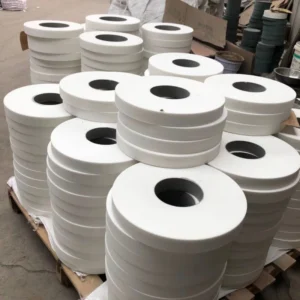
A roll grinding wheel plays a critical role in maintaining the precision and surface quality of industrial rolls. Steel mills, paper mills, and aluminum plants rely on high-performance roll grinding wheels to ensure consistent production quality. Therefore, choosing the correct roll grinding wheel directly impacts surface finish, roundness, and grinding efficiency.
In this guide, we explain how a roll grinding wheel works, where it is used, and how you can select the right specification for your application.
What Is a Roll Grinding Wheel?
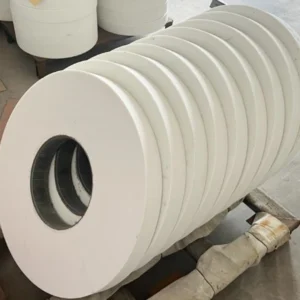
A roll grinding wheel is a precision grinding tool designed specifically for regrinding and maintaining work rolls, backup rolls, and other industrial rolls. Unlike standard cylindrical grinding wheels, a roll grinding wheel must deliver:
- High dimensional accuracy
- Stable structure at large diameters
- Low vibration during CNC grinding
- Consistent material removal rate
Because roll grinding machines operate under heavy load and strict tolerance control, manufacturers must design the roll grinding wheel with optimized abrasive grain, bond structure, and hardness.
Applications of Roll Grinding Wheel
Roll grinding wheels serve multiple heavy industries. For example:
1. Steel Industry
Steel mills use roll grinding wheels to regrind:
- Work rolls
- Backup rolls
- Intermediate rolls
These rolls operate under extreme pressure. As a result, surface precision becomes critical for strip thickness control.
2. Paper Industry
Paper mills require ultra-smooth roll surfaces. Therefore, they often choose fine-grit vitrified roll grinding wheels to achieve superior surface finish.
3. Aluminum & Copper Rolling Mills
Non-ferrous metal rolls require controlled cutting action. In addition, proper abrasive selection helps prevent surface burn and chatter marks.
If you want to understand abrasive differences, you may also read WA vs PA Grinding Wheel Guide.
Technical Specifications of Roll Grinding Wheel
Selecting the right roll grinding wheel starts with understanding its key specifications.
Abrasive Type
- WA (White Aluminum Oxide) – High purity, sharp cutting
- PA (Pink Aluminum Oxide) – Enhanced toughness
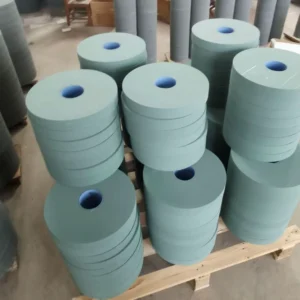
- GC (Green Silicon Carbide) – For special materials
Each abrasive type affects cutting performance differently. Therefore, you must match it with roll material hardness.
Grit Size
Typical grit range:
36# – 120#
- Coarse grit → Higher stock removal
- Fine grit → Better surface finish
Bond Type
Most roll grinding wheels use vitrified bond (V bond) because it provides:
- Strong grain retention
- Thermal stability
- High structural rigidity
For more details about bond types, check Vitrified Grinding Wheel Explained.
Hardness & Structure
Hardness range: H–N
Structure: Medium to open structure depending on cooling requirements.
How to Choose the Right Roll Grinding Wheel
Choosing the correct roll grinding wheel improves productivity and reduces downtime. However, many users select wheels based only on grit size, which leads to poor results.
Follow these steps instead:
1. Identify Roll Material
Is it forged steel, cast iron, or alloy steel? Harder rolls require sharper abrasives.
2. Check Machine Type
CNC roll grinders demand high balance accuracy. Therefore, large diameter wheels must maintain uniform density.
3. Define Surface Finish Requirement
If you need Ra ≤ 0.4 μm, choose finer grit with stable bond structure.
4. Consider Grinding Parameters
Feed rate, wheel speed, and coolant conditions all influence wheel performance. As a result, customized specifications often provide better outcomes than standard models.
You may also explore CNC Roll Grinding Wheel Solutions for advanced applications.
Common Problems in Roll Grinding (And How to Solve Them)
Chatter Marks
Cause: Improper hardness or imbalance
Solution: Use balanced vitrified roll grinding wheel with correct structure.
Burning
Cause: Too hard bond or insufficient coolant
Solution: Select slightly softer grade for better self-sharpening.
Short Wheel Life
Cause: Incorrect abrasive type
Solution: Match abrasive with roll material hardness.
By optimizing these factors, you significantly improve grinding efficiency and roll service life.
Why Choose a Professional Roll Grinding Wheel Manufacturer?
A reliable roll grinding wheel manufacturer ensures:
- Stable raw material quality
- Strict balance testing
- Precision dimension control
- OEM customization
- Fast export delivery
In addition, professional suppliers provide technical support for roll grinding optimization. Therefore, long-term cooperation helps reduce production risk.
Final Thoughts
A roll grinding wheel directly affects production quality in steel and paper industries. When you choose the right abrasive, grit size, bond, and hardness, you improve surface finish, extend roll life, and reduce operational costs.
If you are looking for high-performance roll grinding wheels for steel mills or paper mills, contact us for customized solutions and technical support.